
Point of view · Sales technology · Sales leadership · Group sales
The Experience Layer: Why Specialization Matters at the Customer Boundary
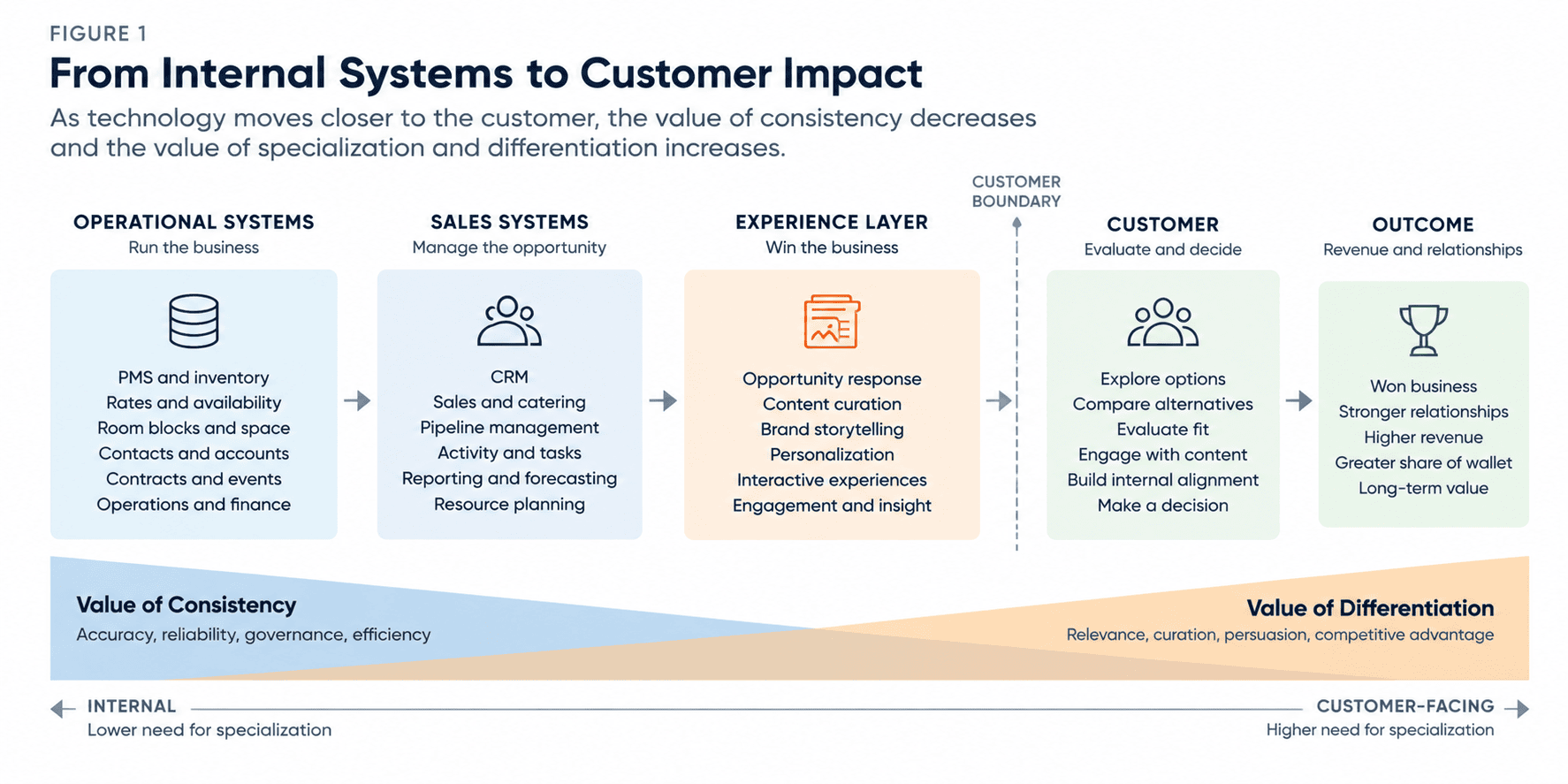
The closer technology gets to the customer, the more specialization matters. Consolidate for consistency. Specialize for differentiation.

On this page
All-in-one or specialized platform
For most of my 30 years in technology, I have watched the same pendulum swing back and forth. At one end is the promise of the all-in-one, so-called “enterprise” platform: one vendor, one database, one login, fewer integrations and less complexity.
At the other end are specialized systems. They solve a narrower set of problems with more concentrated expertise, development resources and attention. They are often built around the specific needs of a particular user, workflow or industry.
That focus can produce greater depth and faster innovation over time. However, it comes with a tradeoff. Every specialized system can also mean another vendor, another interface and another integration. Enterprise platforms make the opposite tradeoff. They spread their development attention across a broader set of capabilities in exchange for greater consistency and consolidation.
Neither approach is inherently better. The more useful question is where each creates the most value.
That distinction becomes especially important as technology gets closer to the customer.
Consolidate where consistency creates value. Specialize where differentiation creates value.
Not all technology has the same job
Much of hospitality technology is operational. These systems manage reservations, rates, inventory, room blocks, accounts, contacts, opportunities, contracts and events. Their job is to organize the business and keep it running.
They deal largely in facts. Is the room available? What is the rate? How many rooms are in the block? Who is the contact? What is the opportunity status? Which meeting space is being held?
For these systems, consistency is a virtue. So are accuracy, reliability, governance and efficiency. A room block does not need to be persuasive. It needs to be correct.
Sales and marketing technology has a different job because it sits closer to the customer. Accuracy is still essential, but it is only the starting point. Information also has to be relevant, differentiated, persuasive and compelling.
That changes what we should expect from the technology.
The closer technology gets to the customer, the more specialization matters.
Think of hospitality technology in layers
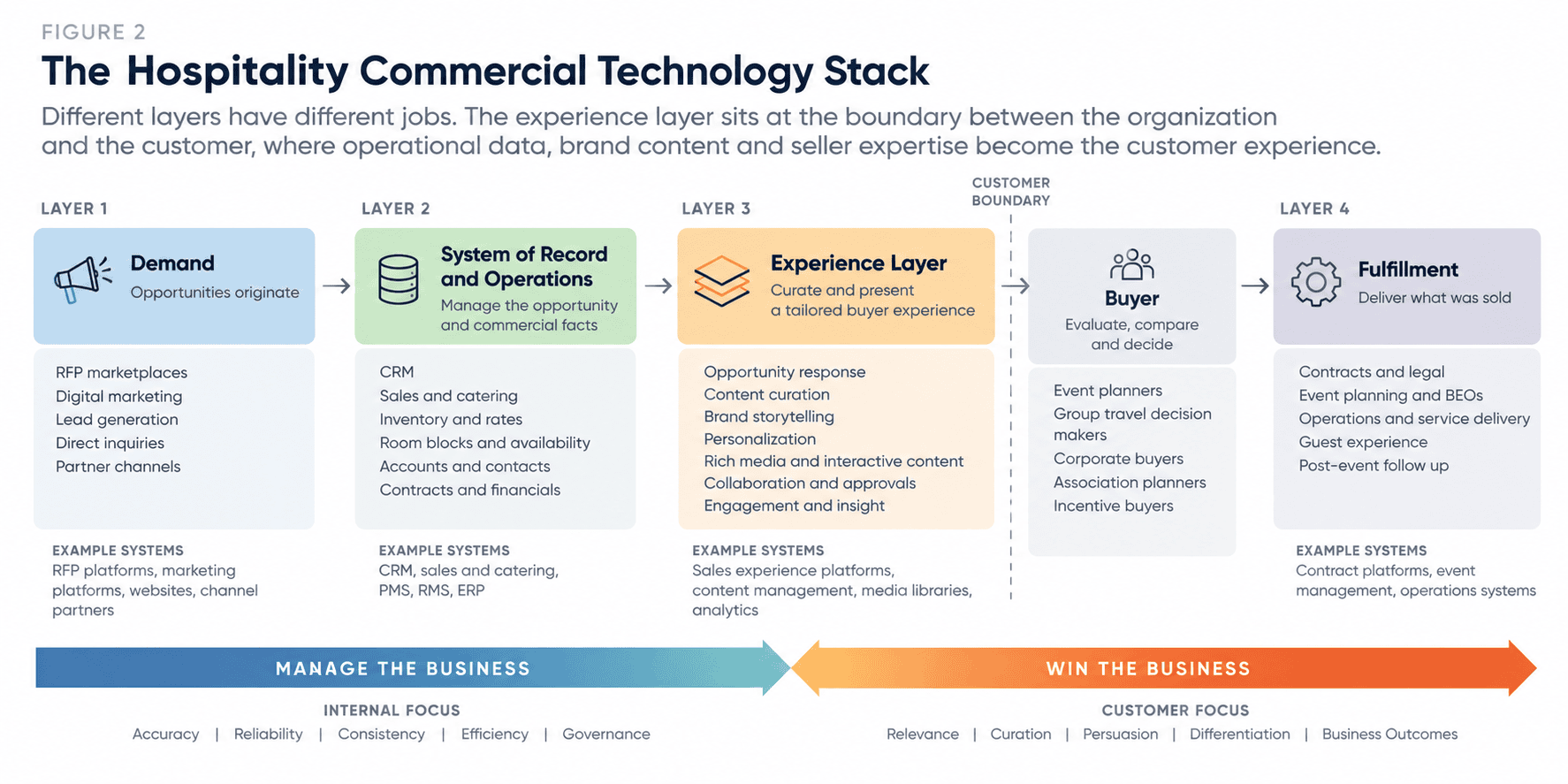
One way to see this distinction is to think about the hospitality commercial technology stack as a set of layers.
The demand layer is where opportunities originate. It includes RFP marketplaces, digital marketing, lead generation and direct inquiries.
The system-of-record and operational layer is where the organization manages the opportunity and the commercial facts around it. CRM platforms and sales and catering systems play a central role here.
Then there is the experience layer. This is where operational data, brand content and seller expertise become the customer-facing sales experience.
Finally, the fulfillment layer is where the business that has been sold moves toward contracts, event planning, operations and service delivery.
These layers do not need to correspond to four separate software platforms. Large systems can and often do span several of them. The point is that each layer has a different job and should be evaluated accordingly.
The experience layer is unique because it sits at the boundary between the organization and the customer. It translates what the organization knows into what the customer needs to understand.
From information to persuasion
The role of sales itself has changed. Daniel Pink1 has written about the shift from a world of information asymmetry to one of information abundance. There was a time when sellers had access to information buyers could not easily get themselves, and having that information created value.
The internet changed that. Today’s buyer can research a hotel, destination or venue before ever talking to a salesperson. They can see guest rooms, meeting space, amenities, restaurants, maps, reviews, videos and competing properties.
Information is no longer scarce. In many cases, there is too much of it.
That changes the role of the salesperson. The job is no longer simply to provide information. It is to help the buyer make sense of it. Sales becomes an act of curation.
This is especially true in hospitality. A hotel or destination may have thousands of pieces of information that could matter to a buyer: guest rooms, meeting spaces, menus, activities, transportation options, floor plans, photographs, videos, virtual tours, rates, concessions and destination experiences.
The buyer does not need all of it. The buyer needs the right information for this event, this group and this decision—at this moment in the process. The information a planner needs to build a short list is different from what they need at the decision stage, when it is down to one or two good options.
Which spaces make sense? What experiences matter? Which images tell the right story? What should we emphasize, and what should we leave out? Why is your property or destination a better fit than the alternatives?
Those are not data-management questions. They are competitive questions that require persuasion, and that is the role of the experience layer.
Operational systems manage information for the organization. The experience layer curates information for the customer.
Specialization matters at the customer boundary
The software industry has spent years moving more functionality into larger platforms, and there are good reasons for that. Consolidation can reduce the number of vendors, simplify procurement, create more consistent data and make security, administration and governance easier.
Those benefits matter. But breadth and expertise are not the same thing.
A platform can add a feature. Expertise is much harder to add.
A system designed to manage sales opportunities can add a presentation function. A presentation platform can add sales features. A CRM can add marketing tools. The question is not whether those features exist. The question is how good they need to be.
An internal board presentation, a training deck and a response to a major group opportunity may all involve assembling information into something visual. But they are not the same problem. The group sales opportunity has a buyer, competitors, hospitality-specific data, brand requirements, a sales process and a commercial outcome.
At that point, small differences matter. Speed matters. Workflow matters. The story matters. Brand expression and personalization matter. The ability to combine operational data with rich content matters. Most of all, understanding the buyer and the selling environment matters.
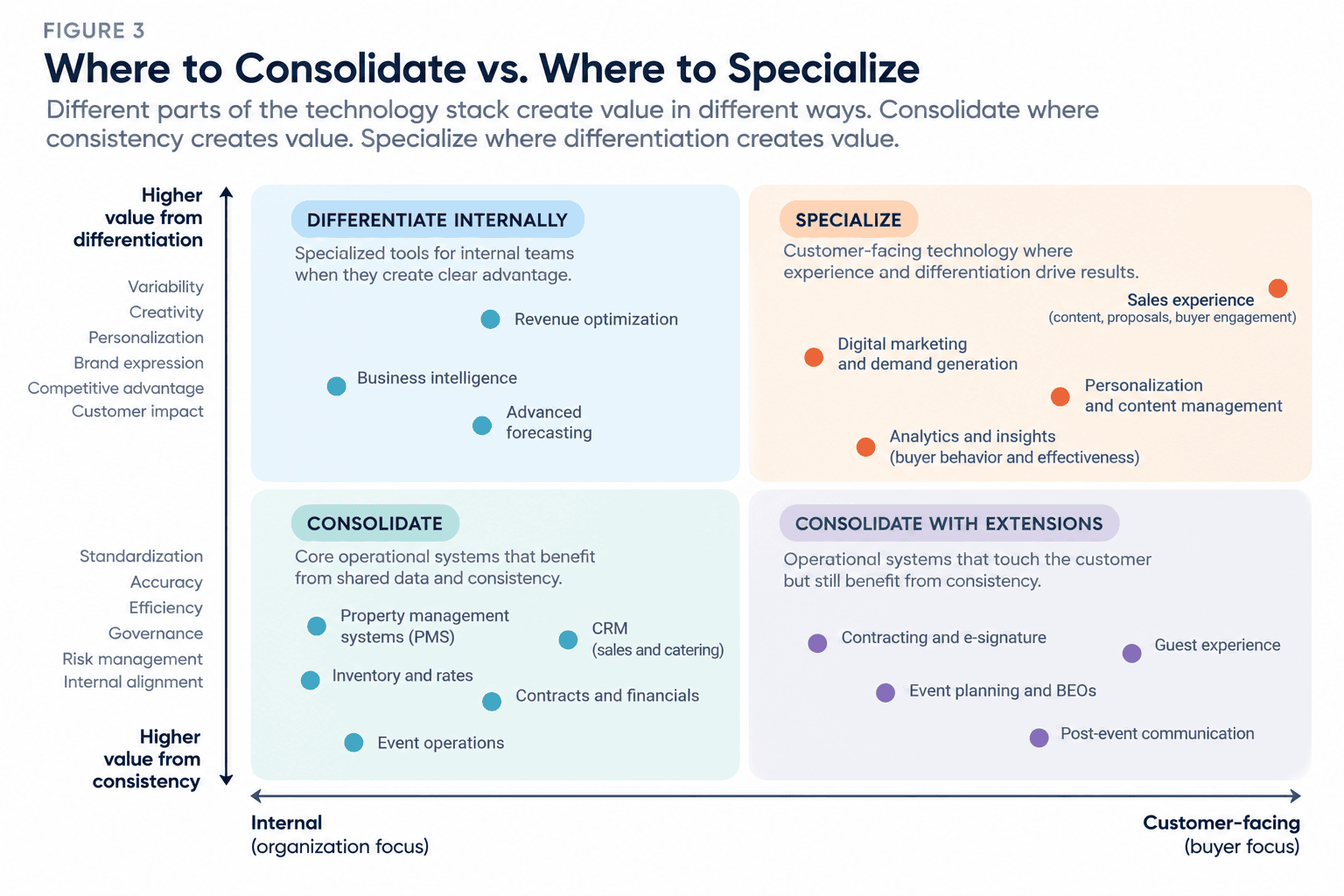
That is why specialization becomes more important at the customer boundary. This is not an argument for adding dozens of disconnected applications to the technology stack. It is an argument for being deliberate about where we accept “good enough.”
Consolidate where consistency creates value. Specialize where differentiation creates value.
The old argument against specialization is getting weaker
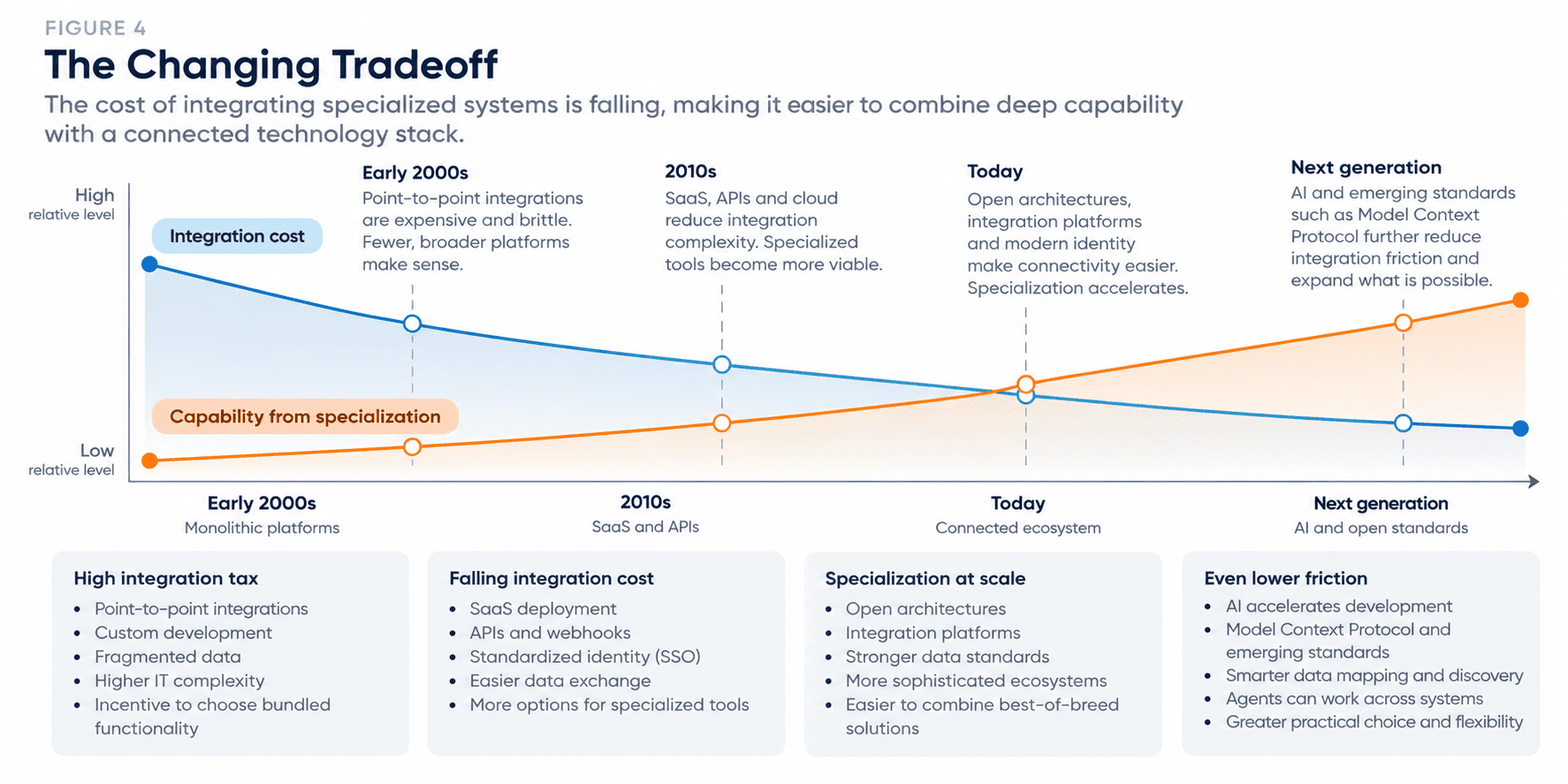
There has always been a cost to specialized technology: integration. Every additional system once meant another database, another vendor and another connection to build and maintain. Point-to-point integrations could be expensive and brittle, data became fragmented, and IT teams inherited more complexity.
That created a rational tradeoff. A company might choose a capability that was merely good enough because it was already part of the larger platform. For many years, the integration tax could outweigh the benefits of specialization.
That tax is falling.
Software as a service (SaaS) is tied revenue to regular renewal cycles. To keep customers paying, software evolved from a one-time setup into a continuously improving service. Open architectures changed how systems are designed. APIs and webhooks made data easier to exchange. Modern identity systems made access easier to manage. Integration platforms made connecting applications simpler.
The next generation of technology will push this further. AI is already making software development and integration work faster. Emerging integration approaches such as Model Context Protocol (MCP) point toward a world in which software and intelligent agents can interact with capabilities across systems more easily.
We should not assume integration becomes effortless. It remains real work. But the technical cost of allowing specialized systems to work together continues to decline, and at an increasing rate.
That changes the tradeoff. If the integration penalty becomes smaller, accepting a weaker customer experience simply because the functionality is bundled into a larger platform becomes harder to justify.
The goal is not fewer systems. The goal is more value with less cost.
Build the stack around where value is created
The pendulum between all-in-one platforms and specialized technology will probably continue to swing, and there are places where consolidation makes enormous sense. Operational technology benefits from shared data, standardized processes and consistency across the organization.
But we should not assume the same logic applies equally to every layer of the technology stack. Customer-facing technology creates value differently because it operates where companies compete for attention, preference and revenue.
It must do more than manage information correctly. It must turn that information into something relevant, differentiated, persuasive and compelling. That deserves specialization.
Modern integration increasingly gives us the opportunity to have both: operational consistency underneath and specialized customer experiences on top.
The future of the hospitality technology stack is not one system trying to do everything. It is operational systems that are exceptional at managing the business, connected to specialized experience technology that is exceptional at helping win it.
Consolidate where consistency creates value. Specialize where differentiation creates value.
Sources
-
Daniel H. Pink, To Sell Is Human: The Surprising Truth About Moving Others (2012) https://www.danpink.com/books/to-sell-is-human/ ↩